


Frequently Asked Questions
Before booking a trip with Stone Horse Expeditions, and up until traveling to Mongolia, many of our guests inquire about details of our back country and wilderness travel, on horseback and other.
Below we have compiled a list of Frequently Asked Questions for you to refer to, and we will keep adding to the FAQ list.
FAQ
Our horses have the best of both worlds. This means they live the good natural life as all Mongolian horses, roaming free as a herd, grazing on natural pastures, with access to creeks and rivers for water, and forests for shade… Living in a herd keeps them mentally healthy, living outside in the natural environment keeps them strong and resilient.
On the other had, unlike most Mongolian horses, they have regular veterinary checks and veterinary emergency care if ever needed. It happens rarely as Mongolian horses are very healthy and strong. But we do have excellent Mongolian veterinarians who know our horses and treat them if needed.
In the winter, usually from November through April, our horses are fed hay in the evenings and grain in the morning. In the daytime, they go out for grazing, pawing in the snow for the freeze dried grasses. They are outside all winter, day and night, but their hay supply, we call it the “Big Wall of Hay” provides a shelter from the cold winter winds. Mongolian horses have a natural, very thick coat in winter. It insulates them so well that snow will stay on their backs after snowfall or a snow storm
In springtime, before the trekking season starts, all Stone Horses have a vet check-up which includes teeth check and teeth floating if needed, hoof clipping and trimming if needed. As the vast majority of Mongolian horses, our horses are barefoot, they do not use horse shoes. Their hooves are very strong and resistant.
The spring time vet check also includes a vitamin shot and de-worming. De-worming is the last step, and its a nice ending to the procedure as the de-wormer is given with a meal of grain to each equine team member.
Springtime is pretty much the only time when they are groomed once to get rid of the remaining winter fluff. This is also the time when they get their signature Stone Horse hair cut. Our guests know the style – a long forelock, short upper mane and long lower mane.
While some horses go on most treks, either as saddle or pack horses, we rotate the horses for trekking duty as much as possible. Also, on each trek, we bring enough horses so there are spares for both saddle and pack horses. There are also rest days on longer treks when all horses (and riders) have a day off. And pack horses have quite a few days off when we set up camp at some locations from where we undertake several day rides.
We carry First Aid Kits for horses (and of course for humans, and also for dogs..) with basic medicines to treat wounds (antiseptics, analgesics, gall salves to prevent sores, topical treatment to prevent fly/larvae infestation), eye infections or irritations, and more. It is very rare that a horse has an injury. Once in a while a horse may get his leg a but tangled overnight in a rope and has swelling which will subside when he stands in cold water for a while. If a horse lamed or limped and we did not want him to put weight on an leg, we have left a horse in the care of a local herder known to our local horsemen. We once transported a horse home on a flatbed truck when his hip seemed in pain – only to find him totally normal by the time he unloaded back home.
With the care and healthy lifestyle our trail horses have they reach ages much older than the average horse in Mongolia and they are active into much older age. Many of our active saddle and pack horses are between 15 and 20 years old and they are doing very well. Once our horses have reached an age where they do get tired on the trail, they begin semi-retirement and eventually are retired. Of our herd of currently 40 horses, 10 – 15 are semi-retired or retired. Some may still be on day ride duties as they are such good reliable trail horses.
Retirement means they live with the herd, are fed with the herd and receive free healthcare like all herd members. If younger herd members bully them, they will have their separate fenced area and receive their meals where bullies cannot get to them. Our honored veterans live out their life in the valley that they know. And they have privileges – like access to wheat bran for several meals a day.. We owe them for all the hard work they put in over their careers as Stone Horses.
Our trail riding saddles for guests are handmade “Stone Horse Saddles”. They are lightweight, approximately 25 lbs, American Western saddles and their “fork” is shaped at a relatively narrow angle. This makes the saddles fit well on Mongolian horses which are smaller than American horses in general and are often high withered. The saddles have a thick, padded underside of genuine sheep wool shearling. Under the saddle, we use two thick saddle blankets to prevent pressure points from the saddle.
Our pack saddles are adjustable to the horse’s size, and the bars of the pack saddles are shaped like the bars of a Western riding saddle, so they fit onto the “pocket” behind the withers of the horse just like a riding saddle. Our pack horse saddle blankets are the extra long ones, made from genuine sheep wool fleeze. The extra long blankets prevent direct contact of the panniers and Utah bags, the boxes and bags hanging on the pack saddles, with the horse’s side’s.
All saddles, riding and pack saddles are sized and shaped so as not to hinder the natural motions of both shoulder plate and hip of the horse in any gait. Our horsemen take great care to pack the loads of the pack horses properly, balanced and not too heavy. And the final touch of packing a horse is the application of the “box hitch” (not the classic diamond hitch of packers) as the box hitch pulls the load away from the side of the horse as it is tightened by the packer.
The following is included in the price listed with each horse trek:
- Airport transfers and hotel accommodation for the first and last nights in a 4-star Ulaanbaatar city center hotel.*
- All meals while traveling outside Ulaanbaatar with Stone Horse
- For guests joining our horse treks, we provide saddle bags, a cantle bag (behind the saddle seat), two stainless steel water bottles, a hygiene kit (toilet paper, hand gel, wet wipes), and a 20 liter waterproof bag for extra clothing and personal items.
- The saddle bags are for clothing and personal items needed during the day on the trail, like rain gear, an extra jacket, gloves, etc.
- The waterproof bag is for clothing and personal items needed only in camp. It is carried by the pack horses and is not accessible during the day’s ride.
- Together the saddle bags and the waterproof bag are about the size of a medium to large backpack, totaling about 40 liters.
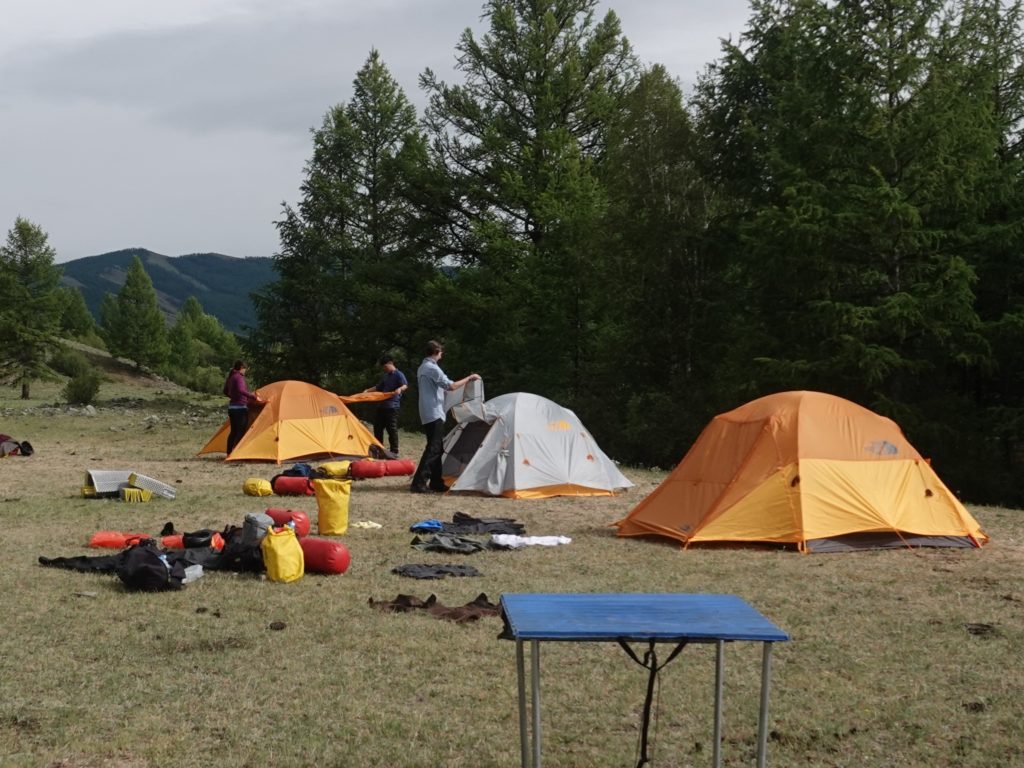
- For camping during horse treks, we provide tent, sleeping bag, inner bags and pillow case, and sleeping mat.
- Helmets and leather half chaps can be issued if the rider does not have or does not want to bring their own. Many riders choose to bring their own fitted helmets and half chaps.
- Dinners in the city are not included in the price. Many restaurants are located near the city center hotel.
*If you want to stay in another hotel or in one of the 5-star hotels in Ulaanbaatar, we can book that, but will re-adjust the price to reflect that change.
Yes, our stated weight limit for riders is 220 pounds (100 kg). However, if the rider is very experienced and fit, a little more may be allowed.
No, in most areas we travel in there is no internet access.
Once we have crossed the pass after about an hours ride from our base camp, there is generally no cell phone signal.
This is a great opportunity for your “digital detox”! You will see that you don’t miss the internet and enjoy being “out of touch”. Riding in beautiful landscapes will take your mind away from the office and your digital devices. We see that this sometimes takes a few days for guests coming from intense corporate jobs. But eventually they realize they are in nature, traveling with great horses, camping, sleeping close to the earth.
Riding the trails as we do can be quite meditative. You are focused, yet relaxed. Moving through a natural landscape, or sitting near a clear river, seeing and hearing the swift current of pure water rush by, is much better than scrolling!
We will be in the Gorkhi-Terelj National Park and or the Khan Khentii Special Protected Area traveling everyday with horses and mostly camping with tents along the way. These are natural areas with little in the way of man-made infrastructure to access internet or phone service.
We do gave satellite communications for emergency purposes, but do not use this for social or business calls.
On Gobi Tours, there will be cell phone signals for parts of the journey as the coverage across rural areas is quite good in Mongolia. On Gobi tours, unless on the more remote Camel Treks and the Gobi Crossing venturing into more remote areas, you are traveling in areas used by nomadic herders, therefore there is a fair chance that one of the country’s telecom companies covers the area. Ask us about SIM cards and E Sim.
There is no access to electricity while on the horse trips. We recommend bringing extra batteries for cameras, or a power bank that can charge your phone several times. You may want to look at solar charger options; for effective solar charging you want one that folds out to generate a larger solar panel surface.
On the Gobi Tours, there is opportunity to charge phones via the vehicle’s 12 Volt charging system. Best to bring your own cable and adaptor/charger for your phone for this.
Yes, you will have the opportunity to take a warm shower in privacy at our camp sites.
We carry a camp shower which can be set up at the camp site, providing opportunity for a quick warm shower in privacy, enough to wash body and hair and feel refreshed.
As we require access to water for the horses and for our own cooking and cleaning needs while camping, we will always be near water. Often we are next to a river, sometimes a lake, and at least a creek.
So there is opportunity to dip and bath, sometimes swim. We ask however, that only biodegradable soaps and detergents are used, and provide water containers for washing/laundry, to use some distance away from open water.
On Gobi tours, showers are available in most ger camps, and we can arrange for a simple washing facility in privacy.
Toilet facilities while traveling in the national park and wilderness are “natural” and discreet. We use the natural area and in a specific way. We provide a hygiene pack with toilet paper, wet wipes, sanitary gel hand cleaner and a lighter for everyone on the trip. We’ll give a short explanation as to how to “go” the natural way. As a preparation, it would be useful to read the book “How to shit in the woods” by Kathleen Meyer. It’s a humorous but fact filled read that will make your time in the woods more enjoyable.
On treks later in the season, when we establish camp for several days or camp amongst herders as during our Autumn Riding Camp, we set up a privacy shelter/tent and make a simple dug out toilet that is sanitary.
Toilet facilities on the Gobi Tours are similar.
Yes, we cater to individual needs and preferences in food and drink.
We send guests a form on food and drink preferences, dietary restrictions and allergies well in advance of the trip. This will give us sufficient time to plan accordingly when we decide on trip menu, and when we shop and pack provisions. Our attention to detail and to guests’ individual dietary needs and wishes is frequently mentioned in guest reviews and testimonials. Also, the camp cuisine in general is often highlighted in guest reviews as being beyond expectations on a remote horse trek.
We cater for individual needs and we serve meals that appeal to all, including those who enjoy Mongolian cooking as well as to guests who rather like to take also international foods or meals they are accustomed to. To this end, two of our team members are active in out camp kitchen. A Mongolian cook prepares hearty Mongolian meals. Her primary job is to cook for our horsemen who prefer Mongolian home cooking. However, we usually serve Mongolian dishes like Tsuivan and Khushuur, and freshly made pan bread “Gambir” and other Mongolian specialties on three or more days during a trek. And if guests prefer Mongolian cuisine, they can join n the horsemens’ meals. For others, the trip leader herself prepares international cuisine breakfasts and dinners that are typically prepared with less or no meat. Our cooking is mindful not only of individual needs, but also of nutritional value.
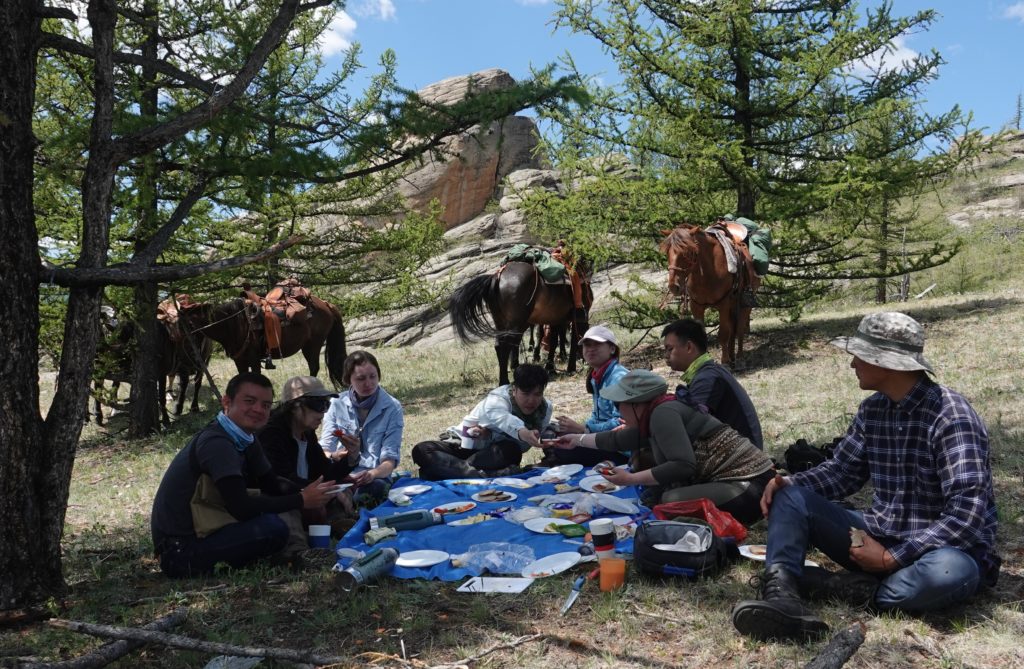
Lunches on the trail, typically taken as a picnic lunch – followed by rest and nap-time – also feature both Mongolian food as well as a spread for guests to prepare their own sandwich to their liking.
Yes, tips for our staff of horsemen, cook, guides, drivers who work with us are much appreciated. They are very hard working people as you will see and they have no problem accepting a tip if you choose to do so. We recommend USD 10.00 per day for each of them for the trips you are on. However, it is up to you what amount you are able and willing to give, and if you feel the service was worth it, feel free to give more than the USD 10.00 per day.
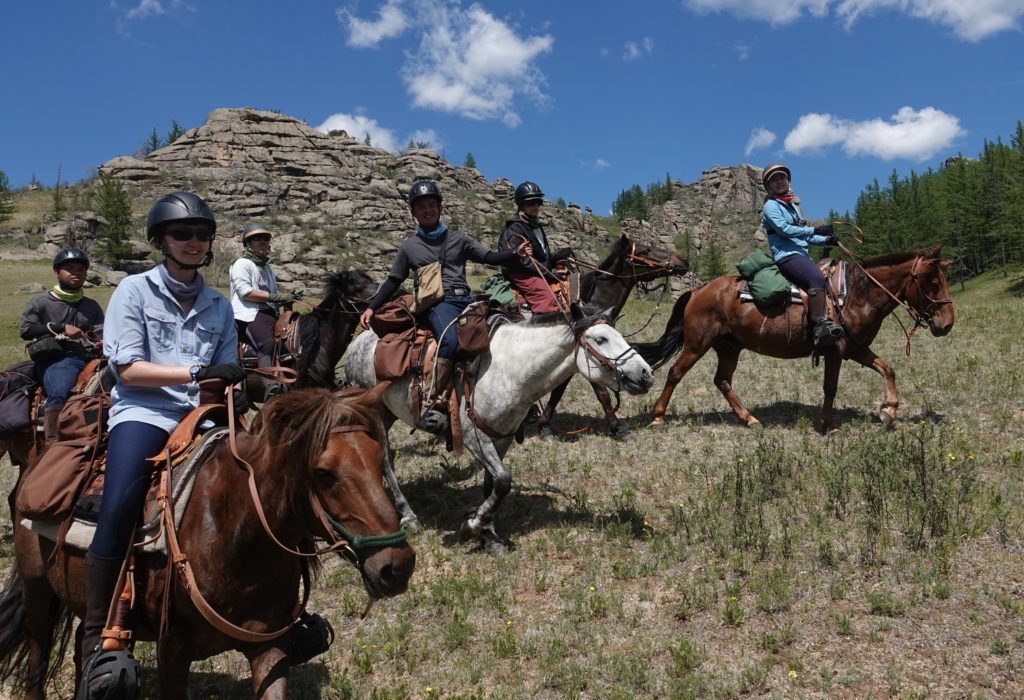
Typically, riding time per day is 5 – 6 hours in the saddle, and most days cover between 25 and 30 kilometers (15 – 20 miles).
Our riding times and distance each day depend on the terrain that we travel, but generally about 6 hours a day in the saddle and between 20 and 40+ kms. We break this up with lunch and personal stops along the way. Mountain passes, rivers and rough ground may determine the distance on a particular day, while open valleys good for trotting and a canter, will see more kms travelled.
Clothing to pack should include the following:
- Warm jacket, either down or synthetic puffer jacket
- Several tops, shirts or T shirts, long sleeve preferable for sun protection, for both warm/hot and cooler weather. Merino T shirt is great in all temperatures except the hottest.
- A HIGH QUALITY rain jacket and pants are VERY important! This does not mean it typically rains a lot. Typically, it does not. But in the summer season, July and early August, afternoon thunder and rain storms are not uncommon, and they can bring HEAVY rain showers. Most “breathable” rain gear will not be really waterproof under these conditions. We ourselves prefer rain gear made from non-breathable fabrics. These could be PVC or PU (Polyurethane) covered materials which are typically used for heavy duty work wear for outdoor and marine work. Other, more modern fabrics are silicone impregnated nylon or the new, non woven, extremely durable DCF (Dyneema Composite Fabric/Cuben fiber). Last not least, there are traditional fabrics coated with rubber used for heavy duty, completely waterproof jackets.
- Top and bottom long underwear. Merino is good. This is for nighttime, and sometimes days may be cool where long underwear is comfortable to have. In the late season, especially in October, long underwear is usually required daily.
- Outdoor pants, or riding pants. If you bring only riding tights, we recommend to also have a pair of hiking pants.
- Socks, several pairs including warm/thick ones.
- Foot wear – a medium weight hiking shoe is a good option as it is well suited both for riding and walking. The terrain can be rough and the ground wet and muddy. Lightweight, English style riding boots are not recommended. A robust riding boot with a higher shaft is a good choice if you don’t opt for the hiking shoes. In any case, bring a second pair of light hiking shoes, runners, for camp.
- Rain boots – you may want to bring a pair of gumboots if you have; otherwise, we also have a selection of gum boots for guests to take on the trek.
- Underwear – you may want to bring a pair of cycling shorts, to wear under our pants/trousers, IF you are not used to riding. This can help prevent chafing, and provide cushioning. A nylon panty hose can also serve that purpose. So does chafing cream or powder that you may want to bring. For ladies, a sports bra is important to have to make your ride comfortable.
- Other items to bring include: a warm hat (wool or pile), and a sun hat/cap, riding gloves, a pair of warm gloves. neck gater.
While you want to cover the essentials, you want to pack lightly. You do not need to bring multiple outfits.
There is a list of clothing and equipment we recommend for our trips in our e-book, “The Right Gear for Expedition Horseback Riding”, which is too long to place here. You can download this for free on this website – look for the box on the right sidebar of most pages.
The e-book has links that will take you to webpages that show the type of clothing article or equipment we suggest for our trips. If you ride horses, hike and backpack, you probably have many of the items already.
There is also a list of clothing items and tips how to prepare for desert travel for our Gobi trips here. It can be downloaded on the Gobi Crossing page, look under “Important Trip Information”.
Stone Horse Expeditions LLC is a company registered and fully licensed in Mongolia. All our staff are Mongolian. Our team members are our greatest assets, and our core staff has been with Stone Horse since the beginning or since very early years – senior administrative staff, lead horseman, chief driver, logistics and camp assistants, accountant, and the herder families who keep an eye on the Stone Horses all year. The core Stone Horse team is paid fair wages year-round, not just during trekking season or for individual treks. That includes all obligations for social insurance and other benefits.
Stone Horse Expeditions has been in business in Mongolia since 2010. With our team, we made it through the COVID-19 pandemic. The benefit was mutual – support through challenging times for our staff and their families on the one hand, and continuity of an experienced and dedicated team to maintain the standard of our operations and quality of services on the other hand.
All our four-legged staff is Mongolian, obviously 😊, so are their family vets. Their hay and grain for the winter is from Mongolian producers. Keeping our own herd of trail horses is not only a horse welfare issue, it is also a safety issue on the trail. We know each of our horses well and can match them with guest riders. And having a team of horses who know their job and each other makes for much more orderly and safe travels, as opposed to having hired horsemen for each trip or one season who each bring their own riding and pack horses. The Stone Horses are an experienced equine team, professionals on the trail who know the routine, the routes and the camp sites. Actually, they know any spot where we have ever stopped for a short break to graze and feel entitled to rest stops there 😊.
We source material and provisions in-country as much as possible, except for some camping equipment.
Stone Horse Expeditions’ origin story is deeply connected to conservation. The owner/operators of Stone Horse Expeditions have lived and worked in Mongolia for more than 25 years. Stone Horse Mongolia was born out of our long term work with park authorities and herder communities in Mongolia, our passion for wilderness and horseback travel, and our years of exploring the landscapes we ride in by ourselves. These are the cultural landscapes of Gorkhi Terelj National Park and the wilderness areas of the Khan Khentii Strictly Protected Area.
Our horse treks are “only” in these protected landscapes, two of Mongolia’s premier parks with unique conservation, cultural, historic and spiritual values. We ride here because
- we are knowledgeable about the areas and routes
- our local horsemen call this area home
- we only run horse treks with our own horses, from their home valley in close proximity of Gorkhi Terelj National Park
- it’s a short distance from Ulaanbaatar city to the Stone Horse Expeditions base camp from where we access these parks
As a company we continue to work closely with park authorities and their frontline staff, the park rangers on the ground. If you have travelled with us, you may have seen the local ranger stop by at our camp, for a cup of tea and a chat. He has known us, and our horses, for more than two decades. And he knows our horsemen well, who are local herders who care about their land and nature, or are volunteer rangers with the park administration. We make a point of paying park entrance fees for guests and our own team according to the law.
Ecological Conduct on Horse Trails and in Camp.
Fire precautions and safety. Camp fires are prohibited at certain times of the year, typically in spring and autumn when the vegetation is very dry and fire danger high. We DO NOT make open camp fires ANY TIME of the year for safety and to avoid damage to the ground and the unsightly appearance of fire pits. It’s not uncommon that we rehabilitate/rewild old fire pits that we come across.
We carry lightweight, collapsable stoves that make for cozy evening and mornings in the heated group tent, and provide a safer and more comfortable “Camp Fire” experience.
Rubbish. For several years, starting in 2015, we organized rubbish collection of accumulated waste around Khagiin Khar Nuur, the wilderness lake where visitation increased significantly in these years. Our own waste management starts at the time of shopping and packing. We avoid or remove packaging of our provisions as much as possible. In camp, ALL waste is collected and it is carried out.
Human waste. and toilet tissue is buried appropriately, that means away from water sources and at a depth in the soil where microbial decomposition is optimal. For campers who are not familiar with these procedures, we give information and instructions.
Camp sites. We chose our camp sites not only for scenic values. Of course, good grass and access to water are the main criteria for a horse trekking camp. However, we make sure to alternate sites and not overuse one site in terms of pasture and water use. In the haymaking season (August and September) we are extra careful not to camp or let our horses graze in hay fields. Having a local horseman on our team who knows the haymaking areas of his local community is very helpful to avoid any mishaps.
Water sources. While we camp near water sources (rivers, streams and lakes) and our guests enjoy a dip or swim after a warm day of riding, we ask that no soaps and detergents or other substances are used in or near the water source. For showering, we provide a camp shower with warm water, set up in a shower tent away from water sources, where soaps and detergents can be used. For small laundry/handwashing of clothing, we provide buckets and soap, likewise to be used well away from the natural water source.
Vehicle travel. For our horse treks, we use pack horses to carry all camping equipment and provisions. This allows us to travel into scenic and remote areas, and we do not use motorized vehicles for our routine horseback travels. The access to our base camp from where our treks start, is by vehicle. It takes a little more than an hour from Ulaanbaatar city center to the Stone Horse base camp and trail head for day rides and multi day horse treks.
Customer Satisfaction
Our guest reviews on Google are overwhelmingly top rating. Customer satisfaction is consistently high across four critical operational aspects: Equine Welfare & Tack, Expedition Logistics & Comfort, Wilderness Immersion, and Guide Expertise & Safety.
The table below provides more insights, with guest names, guest experiences in their own words and the topic they comment on.
| Guest Name | Guest Experiences in their own words.. | Primary Sentiment Theme |
| Thanatchai Surichai | “The stunning Mongolian landscapes, combined with the warm hospitality and well-trained horses, made every moment magical.” | Holistic Experience / Landscape Aesthetics |
| Su Fei | “They look after all their horses including the retired ones and use hand made saddles which are both comfortable and safe.” | Lifelong Animal Welfare & quality horse tack |
| Tifenn Dano Kwan | “This is ‘THE’ horse trek that every other trip will be measured against. We were impressed from the get go…” | Industry Benchmark Excellence |
| Alice Matthews | “The welfare of their animals really is a top priority and they have a great mix of horses to suit all abilities.” | Safety Protocols & Equine Care |
| Caroline H. | “I will never forget this trip! The horses are extremely well taken care off and are a pure joy to ride!” | Exceptional Horse care – exceptional trail horses |
| Catherine Hart | “Stone Horse is TOP NOTCH! The Gorkhi Terelj National Park riding expedition is an epic wilderness adventure on the Mongolian Steppe.” | Wilderness Immersion and Epic Adventure travel |
| Sarah Boland | “There is no better way to experience the Mongolia wilderness than by the back of a docile Mongolian horse.” | Authenticity of Travel |
| Karyn Flynn | “The trip was an incredible value and I hope to be able to return! Mongolia is a must do destination and Stone Horse is the way to do it!” | Perceived Financial Value & Must-Do Destination |
| Jolyn Wu | “Stone Horse owns their own horses and are familiar with their unique quirks so each rider was matched to a suitable mount.” | Personalization & Risk Mitigation |
| Mari Haavisto | “Horses are super nice and alive! I couldn’t image better views than we had in Gorkhi Terelj National Park.” | Scenery & Equine Vitality |
| Joyce Goh | “This company once again exceeds all my expectations. They have an AMAZING and dedicated team, great equipment (saddles, tents, sleeping bags, you name it)…” | Operational Readiness & Equipment Quality |
| Maria Evola | “The people were amazing, organized and responsible sure, but also witty, interesting, and kind.” | Staff skills and care for guests |
| Denise Duong | “An exciting adventure, with great food and camping, beautiful scenery and just an overall extraordinary experience.” | Backcountry Comfort & Gastronomy |
| Gerhard Brand | “The Ultimate Horse Riding Experience… Stone Horse Expeditions has set the bar way up to the top. No head to tail riding. Small groups.” | Trekking Dynamics & Freedom of Movement |
| Alexandra Burke | “Stone Horse horses are unbelievable!… I can recommend their trips for everyone who wants to explore this fascinating country close to nature.” | Great trail horses, experience of natural environment |
| Patricia Burke | “Feel the True Spirit of Mongolia… The forgiving horses accommodate riders of every experience level.” | Cultural Connection & Accessibility |
| Yim Tong Low | “The trip was run with true professionalism. Our team of experienced guides were always alongside to ensure safety.” | Risk Management & Professionalism |
| Martin Trumper | “The food was remarkably good particularly since we were camping and it was also remarkably accommodating to individual requirements.” | Cuisine catering to individual needs |
| Nancy Diehl | “Beautiful scenery, gentle responsive horses, guides with tremendous knowledge…From the outset, it was clear that we were in amazing hands.” | Immediate Trust Building & Authority |
| Johanna Lake | “The horses were wonderful and extremely well cared for. Those peaceful days on ‘the roan’ taking in the amazing scenery will stay with me.” | Lasting Psychological Impact & Peace |
On Trip Advisor, Stone Horse Expedition ratings are also consistently “excellent”. Reviewers on TripAdvisor frequently detail logistical nuances, safety protocols, and emotional resonance of their trips. The following table represents distinct quotes, phrases, and personal observations.
| Guest Name | Guest experiences in their own words.. | Operational Highlight |
| Rae Roberts | “Best trip, best guides. You will be inspired by their knowledge of wilderness conservation, as well as history of the area.” | Intellectual Engagement & Education |
| Liza Popov | “Stone Horse horses are unbelievable! They’re incredibly smart and very forgiving. They know the terrain and take care of you.” | Terrain Navigation, and smart trail horses |
| Nicole Aducci | “As a solo female traveler I never felt uncomfortable or alone….The horses are obviously well-loved and well-cared for.” | Solo Traveler Safety |
| Jim & Shari Shapleigh | “Sabine and Keith do a great job of matching horses with riders and allowing riders to ride at their own comfort level.” | Expert Equestrian Management |
| Wai Ying | “What a great adventure and what a professional outfit Stone Horse is! Bravo… With 8 days of riding, you would want comfort and safety.” | Long trek duration, and assured Comfort |
| Grace Kelly | “A fun filled horseback adventure… with the grasslands and mountain meadows in full color.” | Seasonal Aesthetics & Wildflowers |
| Mary McBride | “It is truly the trip of a lifetime. From day one the trip was expertly planned. The horses are sure-footed and confident.” | Planning Precision & Execution |
| Trish Durlacher | “Everything was well organized but at the same time very relaxed.” | Balance of good organization while keeping a relaxed atmosphere |
| Adrienne | “The overwhelmingly most important thing for me was the horses and the welfare of the horses and they’re just terrific…” | Animal welfare prioritized |
| Pauline | “A truly amazing time… Impressed by the horses, and how they were matched to riders.” | Great horses and matched to riders |
| Sarah Crawley | “Incredible adventure… recalling the professional team… great back country horses, high quality camping equipment.” | Great horses and investment in quality equipment |
| Bonnie L R | “The food was beyond expected. Hot breakfasts and dinners in camp and plentiful lunches under shelter of trees.” | Nutritional Excellence in Isolation |
| Yadin Yeshurun | “All the horses are well trained and extremely safe. I am sure that however choose to ride with stone horse will have an unforgettable… experience.” | Uncompromising Safety Standards |
| Sophie Pages-Oliver | “The countryside we travelled was just phenomenal. I felt really supported by Stone Horse through every step…” | Comprehensive Client Support |
Yes, we accept all levels of riders.
However, of course we recommend that you get some riding lessons and get yourself familiarized with horses, being around them, handling them and spending time in the saddle before joining a horse trek in Mongolia. It is not important to be a perfect rider and some things you learn in a riding school, especially English style riding, will not apply for expedition riding in Mongolia. Ideally, you will have some experience in trotting, as this is a gait the Mongolian horses, and we too, prefer. But, you can learn to trot on the trip, as many guests have done.
Many of our riding guests have gained confidence in riding on a trek with us. An 8 day trek is about 50 hours of riding and the kind of trail riding we do is the best way to learn riding and get to understand horses.
If you are reasonably fit, like the outdoors and are comfortable and confident in the presence of horses, you will be able to do these treks and enjoy yourself. If you doubt you are fit enough, this is your opportunity to get fit. Walking, hiking, cycling are perfect activities to prepare for a horse trek.
What allows us to take riding guests of different levels is the fact that we own and know our horses. We know each of our trail horses well and can match them to the rider. Our horses are well used to their job. Having our own trail horses also makes for smooth traveling as they know each other.
Our horsemen are Stone Horse employees, knowing our herd; they are not hired for the trip and bringing their own horses, as many operators do. If a horse trek relies on horsemen and horses hired on a one-off base it can create challenges traveling with horses from different herds. (it is also a more socially responsible approach to have salaried employees for the season and year round covering salary, social insurance and other benefits)
Last not least, Mongolian horses are generally easygoing. There is often a misconception that they are “wild” because they roam free. But their natural lifestyle makes for a very good mindset. That combined with their amazing instinct, surefootedness in all terrain and incredible endurance, makes them excellent trail horses.
The Stone Horse herd of trail horses is an experienced equine team and we will be able to provide you with a trail companion suitable to your riding experience.
Yes, it is easy to stay connected in large parts of Mongolia by having a SIM card.
There are several options:
- buy a local prepaid SIM card
- With most newer cell phone models, you can download an E-SIM before traveling – one Apps is Airalo, but you will find other suitable Apps too
These SIM Cards are for high speed data, and there are very reasonably priced packages available for travelers.
With your data package, you can then use WhatsApp, Viber and other Apps for calls.
To call from Mongolia, use 001 or the plus sign + before the country code and phone number. Here are examples:
- International Call Format: 001 + Country Code + Phone Number.
- Example (Calling USA): 001 + 1 + Area Code + Local Number.
- Alternative: Use the “+” sign on your mobile phone instead of 001.
The providers with most coverage and best suited for travelers are Mobicom and Unitel
Both providers have counters at Chinggis Khaan International Airport, and you can purchase a Sim card there upon arrival. Ask out driver who picks you up for assistance if needed. You will need your passport to register a SIM card.
If you missed the opportunity at the airport, ask the Stone Horse Expeditions team and we can point you or take you to a Mobicom or Unitel shop in the city where you can get your SIM card.
There are numerous coffee shops in Ulaanbaatar City and increasingly in other parts of the country, namely Aimag (province) centers that provide internet access. The same goes for hotels.
Of course you can bring your own satellite phone. You can rent or buy in your home country, but this remains a pricey option.
On Gobi tours, guests have brought a Mini Starlink set-up. It can be used when traveling by 4×4.
But if you don’t have urgent business or family matters where you need be reachable or able to check in regularly, take your Mongolia travel adventure as an opportunity to disconnect and for “digital detox”
Further Reading
You can find more information on our expeditions, wilderness travel and camping, equipment and more in several of our blog posts, for example:
8 Good Reasons to Choose Stone Horse Expeditions
Ecotourism Adventures on Horseback – 10 Points of Pride